You can spend the whole day solving things and end up feeling you didn’t have a single moment to think calmly.
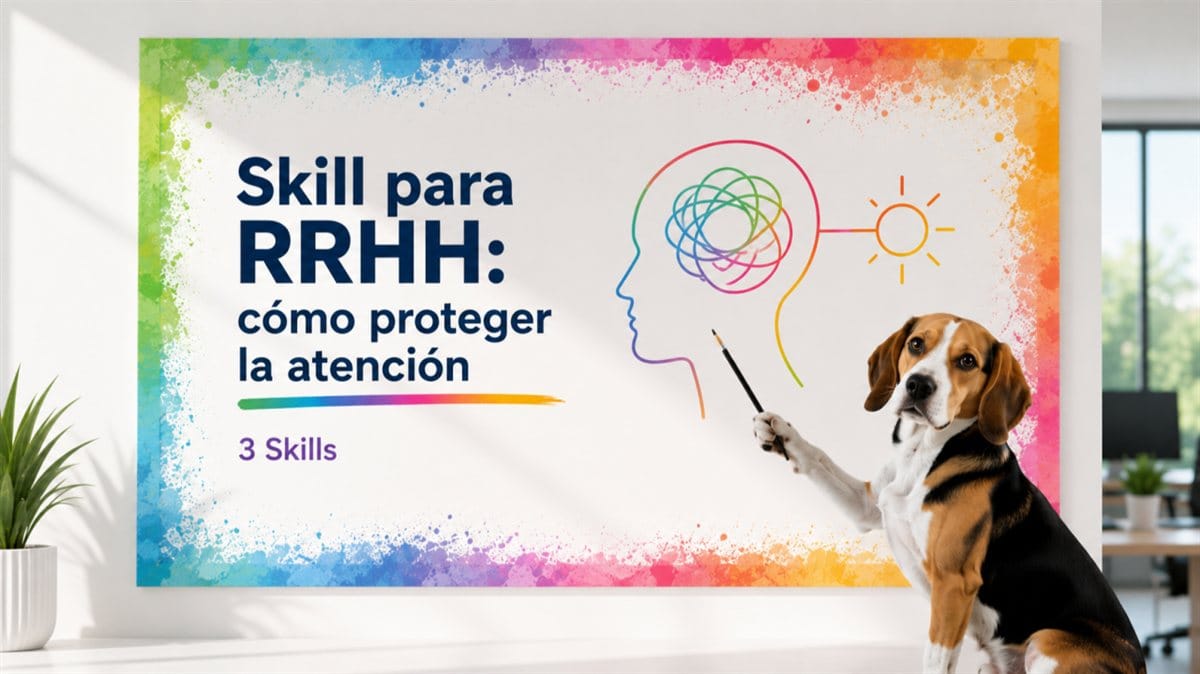
I’m Nara, the mascot of HR professionals, and these days I’ve seen a lot of talk about Magnifica Humanitas, the new encyclical by Pope Leo XIV.
Beyond the religious context it comes from, this text shares a very concrete reflection on the impact of artificial intelligence and the need to protect our capacity to think clearly.
In the encyclical there’s an expression that’s especially important for those who work in HR: the hygiene of attention.
Leo XIV explains that we live surrounded by stimuli that get us used to responding faster and faster.
That immediacy ends up creating tiredness, because the mind stays focused on the next thing that’s going to appear.
In HR this is especially easy to recognize.
When much of the day is spent attending to other people’s needs, every email or every query can claim your attention before you’ve finished processing the previous one.
And receiving a lot of information doesn’t necessarily mean thinking better.
That’s why the encyclical suggests recovering moments of pause that allow us to analyze what we receive more calmly.
It also raises an interesting idea in an era dominated by artificial intelligence: learning to use a tool includes knowing when you don’t need to use it.
Something similar happens with attention.
Protecting it also means deciding when a request can wait and when you need to finish one thing before letting the next one in.
There are three simple skills that can help you protect your attention better day to day.
Skill 1
Distinguishing what’s urgent from what merely interrupts
When you work in HR, many things arrive wrapped in a sense of urgency.
The brain reacts quickly to any new stimulus because it interprets that it may require immediate attention.
That’s why, before switching focus, it can help to ask yourself a very simple question:
“Does this need an answer now, or has it just appeared?”
That pause of a few seconds lets you recover your judgment before reacting.
Protecting your attention starts by preventing every interruption from automatically becoming a priority.
Skill 2
Creating small spaces with no incoming information
The mind needs moments when it isn’t receiving anything new.
When you finish a meeting and open your email straight away, the brain has no space to order what just happened.
Over time, that accumulation creates mental tiredness.
You can start by leaving one or two minutes between one task and the next, especially after an important conversation or before making a decision.
That small space can simply mean closing the screen for a moment, breathing more calmly and asking yourself what you need to keep from what just happened.
The pause doesn’t delay the work.
It often lets you come back to it with more judgment.
Skill 3
Closing one thing before opening the next
There are tasks that end on the outside but stay open on the inside.
This happens especially after a delicate conversation, when part of your mind keeps going over what was said while you’re already dealing with another matter.
That’s why it can help to make a small closure before moving on to the next task.
It’s enough to write a single sentence:
“The next step is this.”
When you leave a record of what to do next, the mind no longer needs to keep holding the whole situation internally.
That gesture frees up mental space and lets you be present again in what’s in front of you.
Humántica®
Attention doesn’t depend solely on deciding to concentrate more, but on the internal state you’re working from.
When the body stays in tension, any stimulus seems more urgent.
When the mind has spent hours jumping from one matter to another, it loses its ability to order things.
And when a conversation stays open inside, it’s hard to be present in the next thing.
That’s why protecting attention means recovering moments of balance.
Humántica® is the approach we integrate into every learning experience, whether in communication, leadership or team development.
Its very name unites the human and the applied technique.
We work with body, mind and emotion so that people can better integrate what they’ve learned and apply it with more clarity in their day to day.
And perhaps that’s why this reflection from Magnifica Humanitas connects so much with the way we work.
At a moment when artificial intelligence takes up more and more space, caring for the human also means protecting attention and the capacity to decide calmly.
Because the more tools advance, the more important it becomes to care for the person who uses them.
I’ll still be around here, watching closely how you work… and learning too from everything you hold up each day.
And who knows, maybe at some point we’ll cross paths at the office. I almost always go with Berta to her meetings with HR.
— Nara
P.S.: What do you think is the biggest enemy of attention?